


AgeMate vs Tmrw vs For Youth: More Ingredients, Better Dosing, or a Targeted Age Defence System?
|
|
Time to read 15 min
|
|
Time to read 15 min
If you've been comparing AgeMate vs Tmrw, you've probably noticed both brands sound pretty similar in their marketing. Daily longevity drink. NMN. Science-backed. Replace your supplement stack. The reality, once you get into the formulas, is that they're built on different ideas about what actually makes a longevity supplement work.
AgeMate gave Australians their first accessible entry into daily NMN supplementation. A focused formula and a morning ritual that's shipped well over 1 million bottles worldwide. Its local Sydney manufacturing is a more recent development, introduced as part of the 2026 TGA-compliant reformulation covered below. Tmrw came along promising something bigger: 88 ingredients in one scoop, built to address all 12 hallmarks of ageing at once.
And then there's a third option that most people don't discover until they look beyond the two obvious choices: the For Youth Age Defence System. Three capsules formulated with scientific advice from Dr Jan Gruber and Dr Vincenzo Sorrentino, longevity scientists who hold professorships at the National University of Singapore (NUS). No drink. No shaker. Just targeted, bioavailable ingredients designed around the specific mechanisms of cellular ageing. Worth keeping in mind as you read on: a compound's value isn't just what's on the label, it's how much of it your body actually absorbs.
Here's how all three actually compare.
Table of contents
Quick answer, if cost and simplicity matter most while only covering 6 out of 12 hallmarks of ageing, AgeMate. If you want the broadest single-scoop formula and can live with some undisclosed doses or cheaper forms of some compounds, Tmrw. If you want every core mechanism of ageing covered with only fully-verified and most bioavailable compounds, the Age Defence System.
Here's a side-by-side snapshot:
| Format | NMN dose | CD38 inhibition | Sirtuin activation (Pterostilbene) | Antioxidant strategy | Autophagy / senolytic support | Absorption technology | TGA-listed | 3-month cost (AU approx.) | Time to take |
|---|---|---|---|---|---|---|---|---|---|
| Powder drink | 500 mg (CellVive) | Nil | Nil (pterostilbene removed for TGA compliance) | Vitamins C + zinc | Nil | Standard | Yes (ARTG 522298) | AUD $237 (3 × $79/mo sub; no 3-month plan) | Mix + drink + wash shaker |
| Powder drink | 500 mg | Apigenin (dose undisclosed) | Pterostilbene 50 mg | Glutathione 300 mg, ALA 100 mg | CaAKG 950 mg, Fisetin (clinical dose, dose undisclosed), Urolithin A, Quercetin (doses undisclosed) | Standard | No (TGA-licensed facility) | AUD ~$387 (3 × ~$129/mo; USD ~$267) | Mix + drink + wash shaker |
| 3 capsules | 450 mg (Uthever®, 99%+ purity) | ApiAge® Apigenin 50 mg | Yes — Pterostilbene 50 mg | Setria® Glutathione 250 mg + PureBKale™ Glucoraphanin 150 mg (dual pathway) | SuperMide® Spermidine HCl 10 mg + Quercefit® Quercetin Phytosome 250 mg + Meriva® Curcumin Phytosome 250 mg | Phytosome (curcumin + quercetin) | No (EU GMP) | AUD $432 (full 3-product system, 3 × $144/mo) | 3 capsules (~3 seconds) |
The snapshot above simplifies. Here is the fuller picture, grouped by function rather than brand marketing copy, including what each formula leaves out.
| Format | NMN dose | CD38 inhibition | Sirtuin activation (Pterostilbene) | Antioxidant strategy | Autophagy / senolytic support | Absorption technology | TGA-listed | 3-month cost (AU approx.) | Time to take |
|---|---|---|---|---|---|---|---|---|---|
| Powder drink | 500 mg (CellVive) | Nil | Nil (pterostilbene removed for TGA compliance) | Vitamins C + zinc | Nil | Standard | Yes (ARTG 522298) | AUD $237 (3 × $79/mo sub; no 3-month plan) | Mix + drink + wash shaker |
| Powder drink | 500 mg | Apigenin (dose undisclosed) | Pterostilbene 50 mg | Glutathione 300 mg, ALA 100 mg | CaAKG 950 mg, Fisetin (clinical dose, dose undisclosed), Urolithin A, Quercetin (doses undisclosed) | Standard | No (TGA-licensed facility) | AUD ~$387 (3 × ~$129/mo; USD ~$267) | Mix + drink + wash shaker |
| 3 capsules | 450 mg (Uthever®, 99%+ purity) | ApiAge® Apigenin 50 mg | Yes — Pterostilbene 50 mg | Setria® Glutathione 250 mg + PureBKale™ Glucoraphanin 150 mg (dual pathway) | SuperMide® Spermidine HCl 10 mg + Quercefit® Quercetin Phytosome 250 mg + Meriva® Curcumin Phytosome 250 mg | Phytosome (curcumin + quercetin) | No (EU GMP) | AUD $432 (full 3-product system, 3 × $144/mo) | 3 capsules (~3 seconds) |
*A single unbiased numeric score across 88 ingredients with several undisclosed doses isn’t something we can responsibly produce. This row reflects breadth versus depth of approach, not a weighted score, and ties back to the hallmarks framework discussed below. |
Two things sit behind those hallmarks comparisons in the table above. First, a probiotic and prebiotic blend is not the same as a validated gut-health longevity intervention. A fibre-rich diet or daily yoghurt plausibly does as much for microbiome diversity as 10 billion CFU stacked in alongside 80-odd other actives, so the Age Defence System not including a probiotic layer is not really a gap in its longevity coverage. Second, enhanced delivery forms like phytosomes cost meaningfully more per ingredient than standard extracts. A formula that uses standard forms across 88 compounds and one that uses phytosome delivery for two targeted compounds are not comparable on dose alone.
Fitting 88 ingredients into one affordable scoop all but requires using the cheaper, less bioavailable version of most of them. The Age Defence System touches fewer hallmarks, but the compounds it does include are more likely to actually reach the tissue they're meant to target, which matters more than the raw count.

AgeMate built the NMN morning ritual in Australia, and that's genuinely worth acknowledging. The Daily Longevity Blend put NAD+ science in front of people who had never heard of it, and the formula is honest about what it's trying to do.
It's TGA-listed (ARTG 522298) and manufactured in Sydney. For Australian buyers who want a compliant, locally made NMN product, this is still the most straightforward option on the market.
The formula covers a broad spread of longevity support in a single 3.3 g scoop:
NMN 500 mg (CellVive) for NAD+ restoration and cellular energy
Glycine for collagen support, joint integrity, restful sleep, and as a calming neurotransmitter
Magnesium, Vitamin D3, K2, B12, folate, biotin, zinc, vitamin C for micronutrient coverage
L-Theanine 200 mg (AlphaWave®) for cognitive calm
L-Theanine is well studied for focus, stress, and sleep quality, and there is a reasonable case for morning use: it can sharpen focus and reduce caffeine jitters, with peak effects arriving within 30 to 60 minutes. It is not, however, a longevity compound in the scientific literature. For anyone focused specifically on the mechanisms of cellular ageing rather than general cognitive support, its presence in a longevity stack is worth noting.
Magnesium is a different story. It's involved in hundreds of enzymatic reactions and cellular energy processes. A sensible daily addition regardless of the context.
The 2026 TGA reformulation required AgeMate to remove two key compounds from its Australian formula: pterostilbene and spermidine.
Pterostilbene is a sirtuin activator. Sirtuins are longevity-related proteins that depend on NAD+ to function. Removing it means the current formula raises NAD+ without the sirtuin-activation layer that strengthens it. Spermidine drives autophagy, the cellular cleanup process that clears damaged components before they accumulate. Its removal leaves a gap in autophagy support that the formula does not otherwise address.
Neither removal is a quality decision by AgeMate. Both were required for TGA compliance. But the practical result is a formula that is narrower in mechanism coverage than its pre-2026 version.

Tmrw was developed by Simply Nootropics, the New Zealand brand behind a well-known NMN and nootropics range, relaunched under its own brand in 2025. The pitch is ambitious: 88 ingredients in one daily scoop, built to address all 12 hallmarks of ageing simultaneously.
Worth flagging before the ingredient list: fitting 88 actives into one scoop at a competitive price point tends to mean using standard, non-enhanced ingredient forms. That is partly a cost consideration, partly a formulation constraint. The practical result is the same either way: several actives below have poor bioavailability in standard form, meaning a portion of what is on the label does not reliably reach the tissues that need it.
Some of those headline ingredients are genuinely impressive at a first glance:
NMN 500 mg for NAD+ restoration
Pterostilbene 50 mg as a sirtuin activator
CoQ10 150 mg for mitochondrial energy production (standard form, not phytosome-delivered)
CaAKG 950 mg for autophagy induction (standard-release; more on why that matters below)
Taurine 1,500 mg for cardiovascular and metabolic support
Apigenin as a CD38 inhibitor [cd38_camacho] (dose not publicly disclosed)
Urolithin A, Fisetin, Quercetin as senolytics (absorption caveats below)
10-strain probiotic blend at 10 billion CFU
Adaptogens: Rhodiola Rosea, Ashwagandha, Lion's Mane
Nootropics: L-Theanine, Citicoline
It is NSF Certified for Sport®, made in a TGA-licensed New Zealand facility, and priced at USD $89/month (approximately AUD $129-135).
Two of those ingredients deserve a closer look. CaAKG is a good addition on paper, but a landmark May 2026 study in Aging Cell, testing 84 longevity compounds and drugs against a DNA methylation age clock, found that only delayed-release CaAKG (branded as Rejuvant) produced a statistically significant reduction in biological age.
Standard-release CaAKG, the form a powder drink is limited to, showed an effect roughly eight times weaker and not statistically significant. This reflects a fundamental limitation of the drink format: delayed-release or enteric-coated capsule delivery, which makes a meaningful clinical difference for CaAKG, is simply not possible in a product you dissolve in water. That constraint applies across any compound where coating or controlled release changes outcomes. Tmrw's 950 mg CaAKG dose is real, but may not deliver what the research associates with significant results.
Fisetin faces a similar challenge. Poor water solubility limits how much dissolves in the gut in the first place. But what does dissolve still faces a second obstacle: rapid breakdown by liver and gut enzymes through first-pass metabolism, before the compound reaches circulation. Studies suggest only a small fraction of a standard oral dose becomes systemically bioavailable. Neither issue is disclosed on the label, and neither is unique to Tmrw, but both add another layer to the dosing question: even a disclosed dose only matters if the body can absorb and retain it.
Here's the thing. A standard powder serving sits somewhere between 10 and 14 grams. When you're fitting vitamins, minerals, probiotics, adaptogens, senolytics, and longevity actives into that space, some ingredients are going to get small doses. Others get almost nothing.
Tmrw publishes the key numbers clearly: 500 mg NMN, 150 mg CoQ10, 950 mg CaAKG, 1,500 mg taurine. Those are solid, clinically relevant figures. What is less transparent is the dosing for the 60+ ingredients sitting behind those headliners. Take apigenin as an example. Its job is to inhibit CD38, the enzyme that accelerates NAD+ degradation as we age [cd38_camacho]. How much apigenin you're getting matters significantly for that function. Tmrw lists it as an ingredient. The dose isn't published, and that's a choice, not a limitation of the format. A contract manufacturer has to be told an exact quantity for every single ingredient before they can blend a batch, so the brand knows the number. Leaving it off the label is a transparency decision.
That's not unique to Tmrw, but it matters more, not less, at this price point. Buyers who expect third-party testing on a premium longevity product are the same buyers who'd want full dosing disclosed.
There's a second, more concrete flag worth raising here. Tmrw states it isn't aware of any interactions between its formula and medications. But quercetin, sitting in that same undisclosed group of compounds, has a well-established interaction with blood-thinning medications at clinically active doses. Either the quercetin dose is too low to be clinically meaningful, which raises its own questions about why it's included, or the interaction disclosure is incomplete. Neither is especially reassuring.
AgeMate's founder, Ben, has addressed the AgeMate vs Tmrw comparison directly inside their private community, noting that fitting a very large number of ingredients into a fixed daily serving raises legitimate questions about what each compound actually gets in terms of dose. The argument that more ingredients equals better coverage only holds when you can verify the dose of every single one. AgeMate members can read the original discussion thread directly in the community group. It is free to join and registration is open.
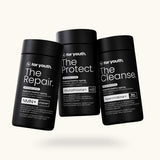
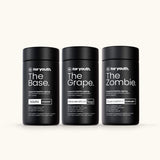
The Age Defence System isn't trying to win on ingredient count. It's built around a different question: what are the minimum effective compounds, in the most bioavailable forms, to address the core cellular mechanisms of ageing?
The answer is three capsules. No drink to mix. No shaker to wash.

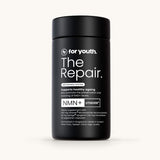
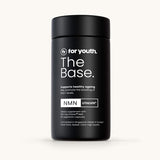
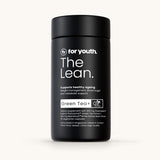
The Repair is the NAD+ engine of the system, and it goes further than any drink on this list in how it approaches that job.
Uthever® NMN 450 mg (99%+ purity): The most clinically studied NMN form available. Purity matters more than most brands admit. A 2024 study found that actual NMN content varied by up to 100% from label claims across 18 commercially tested supplements [Sandalova_NMN]. Verified purity at the batch level is the only way to know what you're actually taking.
ApiAge® Apigenin 50 mg: Inhibits CD38, the enzyme that degrades NAD+ as we age [cd38_camacho]. Boosting NAD+ without blocking CD38 is like filling a bucket with a hole in it. The dose is disclosed clearly.
Pterostilbene: Activates sirtuins, the longevity proteins that rely on NAD+ for DNA repair and cellular maintenance. This is the compound AgeMate had to remove from its Australian formula to meet TGA requirements. For Youth retains it in capsule form.
The triple-pathway logic here: NMN raises NAD+, apigenin prevents its breakdown, pterostilbene activates the sirtuins that use it. Each step is distinct. Each amplifies the others. You can verify the batch purity of every product on For Youth's testing page.
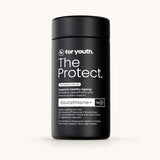
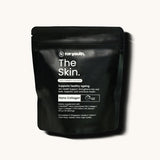
The Protect takes a dual-pathway approach to oxidative stress that most supplements don't bother with.
Setria® Glutathione: The most studied oral form of the body's master antioxidant. Delivers active glutathione directly at the cellular level.
Sulfodyne® Sulforaphane (via PureBKale™ Glucoraphanin precursor): Activates the Nrf2 pathway, stimulating the body's own internal antioxidant production from within.
Most antioxidant supplements take one approach or the other. The Protect uses both. That dual mechanism matters because oxidative stress operates through multiple pathways simultaneously, and hitting only one of them leaves the others running unchecked.
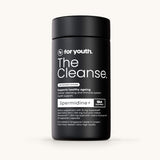
The Cleanse drives autophagy, the cellular cleanup process that clears damaged components before they accumulate and accelerate ageing.
SuperMide® Spermidine HCl 10 mg: Activates autophagy to mimic the cellular renewal benefits associated with fasting.
Meriva® Curcumin Phytosome™ 250 mg: Curcumin delivered via phytosome technology for dramatically improved absorption [curcumin_marczylo].
Quercefit® Quercetin Phytosome™ 250 mg: Senolytic support using the same patented phytosome delivery.
The phytosome technology in the last two ingredients is worth understanding. Standard curcumin is notoriously difficult for the body to absorb, a problem so well documented it's used as a benchmark for poor bioavailability in pharmaceutical research [curcumin_marczylo]. Meriva® binds curcumin to a phospholipid complex that substantially improves how much reaches the bloodstream. At equivalent doses, Meriva delivers significantly more active compound to the tissues that actually need it. Quercefit applies the same logic to quercetin. The number on the label isn't the number your cells see without this technology.
Fair comparison requires saying this clearly. AgeMate includes magnesium and L-Theanine, neither of which is in the Age Defence System.
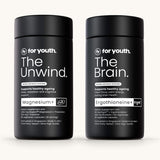
Magnesium is a sensible daily inclusion for most people, given its role in cellular energy and enzymatic function. L-Theanine has real benefits for stress and sleep. For Youth offers it separately in The Unwind for that purpose, and for the broader adaptogen and nootropic ground Tmrw covers (Rhodiola, Lion's Mane, Bacopa, Citicoline), the Neuro Defence System (The Brain + The Unwind) is the closer match. But in the context of a longevity mechanism stack, none of it belongs alongside NMN, apigenin, and spermidine.
In 2013, scientists mapped the biological mechanisms that determine how a body ages. The 12 Hallmarks of Ageing [hallmarks_lopez] framework, updated in 2023, covers mitochondrial dysfunction, genomic instability, cellular senescence, chronic inflammation, gut dysbiosis, and more. It's the most complete scientific model of ageing we have. You can read how these hallmarks translate into real supplementation decisions on the For Youth magazine.
AgeMate's formula concentrates on the hallmarks most directly tied to NAD+ and mitochondrial function. A solid foundation, but a narrow band of the full twelve. Tmrw's 88-ingredient spread touches more hallmarks on paper, but coverage is uneven, particularly for compounds without disclosed doses. The Age Defence System is designed to target all 12 hallmarks across its three-product system: The Repair addresses NAD+ metabolism, genomic instability, and epigenetic alteration; The Protect covers oxidative stress, mitochondrial dysfunction, and chronic inflammation; The Cleanse targets disabled autophagy and cellular senescence. Gut dysbiosis, one of the twelve, is addressed more indirectly through the system's anti-inflammatory and cellular renewal mechanisms than through a dedicated probiotic layer, but all 12 hallmarks are within scope.
Fewer mechanisms addressed precisely can outperform many mechanisms addressed superficially.
One assumption worth challenging before you decide: the idea that a daily drink is simpler than capsules.
Mixing a powder with 300-360 ml of cold water, drinking it before the nutrients start degrading, and rinsing a shaker takes three to five minutes each morning. Three capsules take roughly ten seconds. For anyone who travels, forgets their shaker, or simply doesn't enjoy breaking the fast with a big glass of coloured liquid first thing, capsules are the more consistent format. In longevity supplementation, consistency is what actually drives results.
You want a TGA-listed product manufactured in Sydney
You're new to NMN and want a straightforward daily drink with a strong Australian community behind it
AUD $79/month on subscription is the right price point
Local shipping from Sydney and a familiar format are important to you
You want the broadest possible coverage in one scoop: gut health, adaptogens, senolytics, mitochondrial support, and NAD+ in one formula.
You're comfortable with a New Zealand origin and no TGA listing for the product itself.
USD $89/month (approx. AUD $129-135) is within budget.
NSF Certified for Sport testing is a priority for you.
You want targeted, precision-dosed coverage of the core cellular mechanisms of ageing with premium, patented ingredients at verified doses.
You prefer capsules over a morning drink, or have had digestive sensitivity with powder formats.
You want pterostilbene and CD38 inhibition in your NAD+ stack, both of which are absent from AgeMate's current Australian formula.
You already take AgeMate for NMN and want to add what its formula doesn't cover, pterostilbene-based sirtuin activation and CD38 inhibition, without stacking a second NMN dose: The Protect and The Cleanse alone cover this without duplicating AgeMate's NMN
You want batch-level lab results published for every product you take
For a broader look at the NMN landscape before you decide, our full NMN supplement comparison for Australia covers the full category in depth, including how AgeMate stacks up against eight other options.
DisclaimerThe information in this article is for educational purposes only and is not a substitute for professional medical advice, diagnosis, or treatment. Always seek the advice of a qualified healthcare provider with any questions you may have regarding a medical condition or before starting any new supplement, diet, or exercise programme. For Youth products are food supplements intended to support general wellbeing and the body's own NAD+ levels. They are not medicines and are not intended to diagnose, treat, cure, or prevent any disease or its symptoms. These statements have not been evaluated by a medicines regulatory authority. |
About For YouthFor Youth is a science-led longevity brand focused on developing clinically relevant supplements that support healthy ageing and performance at the cellular level. Formulated in collaboration with leading academic researchers, the brand prioritises evidence-based ingredients, advanced delivery technologies, and transparent quality standards. |
Related product

The Age Defence System
$150.00 SGD
$177.00 SGD

 Tmrw
 The Age Defence System by For Youth
 AgeMate
 Tmrw

